

What TOEIC actually tests
The Test of English for International Communication is known as TOEIC. TOEIC is designed with the office in mind, in contrast to TOEFL or IELTS, which are based on academic English. This test operates in the world of emails, meetings, phone messages, schedules, invoices, and workplace conversations.
- The TOEIC Listening and Reading test, which practically everyone takes, is one of two distinct TOEIC exams. It takes roughly two hours to complete, with 200 multiple-choice questions divided into a 45-minute listening portion and a 75-minute reading portion
- TOEIC Speaking & Writing is a separate, optional computer test that is typically taken by those who need to demonstrate that they are capable of speaking and writing in a professional context rather than just identifying the right answers.
Reading and listening each contribute up to 495 points on the Listening & Reading test, which has a score range of 10 to 990. Each skill on the Speaking and Writing test receives a separate score of 200.
Inside the Listening & Reading test
7 parts make up the listening portion.
It begins simply: you look at a picture (part 1) and choose the best sentence to describe it (part 2), but it quickly picks up speed.
By Parts 3 and 4, you are listening to both lengthy and brief talks while responding to three questions each. You are not given the option to play back the audio.
Because people freeze the first time they hear a fast, natural conversation rather than a slow, textbook one, this is where the majority of points are lost. You can set your own pace in the reading portion, which is both a relief and a trap.
Part 5 uses sentence completion to test vocabulary and grammar. If your grammar is strong, you will receive quick points.
In Part 6, you must fill in the blanks in brief business texts, such as emails and memos, The lengthy section,
Part 7, consists of single, double, and even triple passages where you must cross-reference data from an email, a schedule, and a response in order to determine the correct response. It’s the largest part of the test and what makes a good score stand out from a great one.
What a "good" score actually means
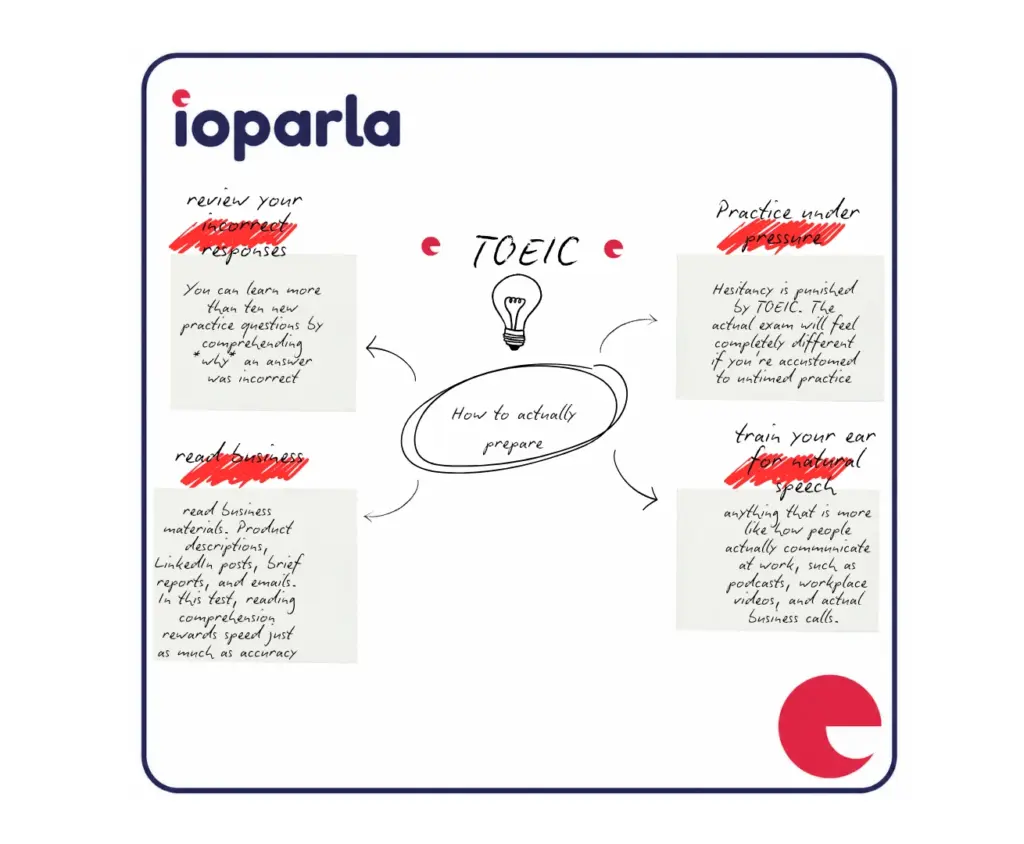
How to actually prepare, without wasting months
Those who improve rapidly differ from those who study for a year and hardly make any progress in a few ways:
- Practice under pressure : Hesitancy is punished by TOEIC. The actual exam will feel completely different if you’re accustomed to untimed practice.
- Instead of listening to slow, overly articulated audio, train your ear for natural speech, anything that is more like how people actually communicate at work, such as podcasts, workplace videos, and actual business calls.
- Every day, read business materials. Product descriptions, LinkedIn posts, brief reports, and emails. In this test, reading comprehension rewards speed just as much as accuracy.
- Carefully review your incorrect responses. You can learn more than ten new practice questions by comprehending *why* an answer was incorrect
Why studying online works so well for TOEIC
The TOEIC is a very format-specific exam. Your score rises quickly once you grasp the traps in each section, and structured online preparation is excellent at developing that kind of pattern recognition without requiring you to make travel arrangements to attend class. IOPARLA can help in this situation. Our platform includes full-length practice tests that mimic the timing of the actual exam, live classes with tutors who are experts on the test, and personalized pace of preparation that pinpoints the precise area that is impeding your score rather than merely advising you to “practice more.”. IOPARLA provides you with a framework to follow rather than a stack of haphazard YouTube. Join the platform through ioparla.com and start where you are and work your way up!