
It’s not necessary to purchase five different books and hope for the best when preparing for the TOEIC, TOEFL, or IELTS. You just need to know where to look and which sources are genuinely worth your time as opposed to those that are recycled content masquerading as advice. There is a lot of good, free content available. In addition to a few general habits that are helpful regardless of the test you’re taking, here is a useful list arranged by exam.
Official sources come first
Learn about the organizations that administer these tests before proceeding. Everything else is secondary; they publish the actual regulations, actual sample questions, and actual registration details.
- ETS.org, the official organization that administers the TOEFL and TOEIC. Sample questions, official score guides, and test center details are all available on their website. This is the place to clarify any scoring or format rules that don’t seem clear elsewhere.
- IELTS.org is the official IELTS website, which is co-managed by Cambridge English, IDP, and the British Council. It includes information on Academic versus General Training, band descriptors, and free sample tests.
- IDP IELTS and British Council are both official IELTS test providers; depending on your area, each has its own test-day instructions, practice materials, and preparation pages.
For TOEIC specifically
- To get the most accurate representation of actual question difficulty and phrasing, start by looking for official ETS TOEIC sample exams.
- Since the exam uses natural, conversational speech rather than slow, textbook audio, business English podcasts and workplace-focused YouTube channels are actually helpful for honing your ear on Parts 3 and 4.
- Reading actual workplace content, such as LinkedIn articles, brief reports, and business emails, develops the precise reading habits that Part 7 promotes.
For TOEFL specifically
- Make sure that any practice materials you’re using reflect the current adaptive test and the 1–6 scoring scale, not the previous 0–120 version, as the exam’s format changed in January 2026. There is still a lot of out-of-date content available.
- University lecture recordings, which are freely accessible from the open courseware programs of several major universities, are a great way to practice academic listening skills and are the closest free substitute for actual TOEFL content.
- Vocabulary-in-context questions in the Reading section directly benefit from a daily review of academic vocabulary lists.
For IELTS specifically
- Because it is created by the same company that administers the actual test, the Cambridge IELTS Practice Tests series (currently up to Book 18) is regarded as the gold standard for realistic practice.
- You should carefully review IELTS.org’s free sample Writing and Speaking tasks and published band descriptors because knowing exactly what examiners score you on affects your writing and speaking from the very beginning.
- One easy, free method to assess your own performance in between practice sessions is to record yourself speaking and compare it to official Speaking band descriptors.
General habits that help across all three exams
Read and listen to real English every day instead of just exam material. Anything current, like news articles, podcasts, and interviews, keeps your ears and vocabulary active. - On the first day, start timing yourself. For all three tests, pace is just as crucial as accuracy, and untimed practice breeds false confidence.
- Keep track of your errors as well as your grades. Ten more practice questions answered automatically are worth more than a study log that explains *why* you made a mistake.
- Even when you’re by yourself, talk aloud frequently. It is the most frequently neglected skill and the one that deteriorates the fastest in the absence of practice.
Why scattered resources only get you so far
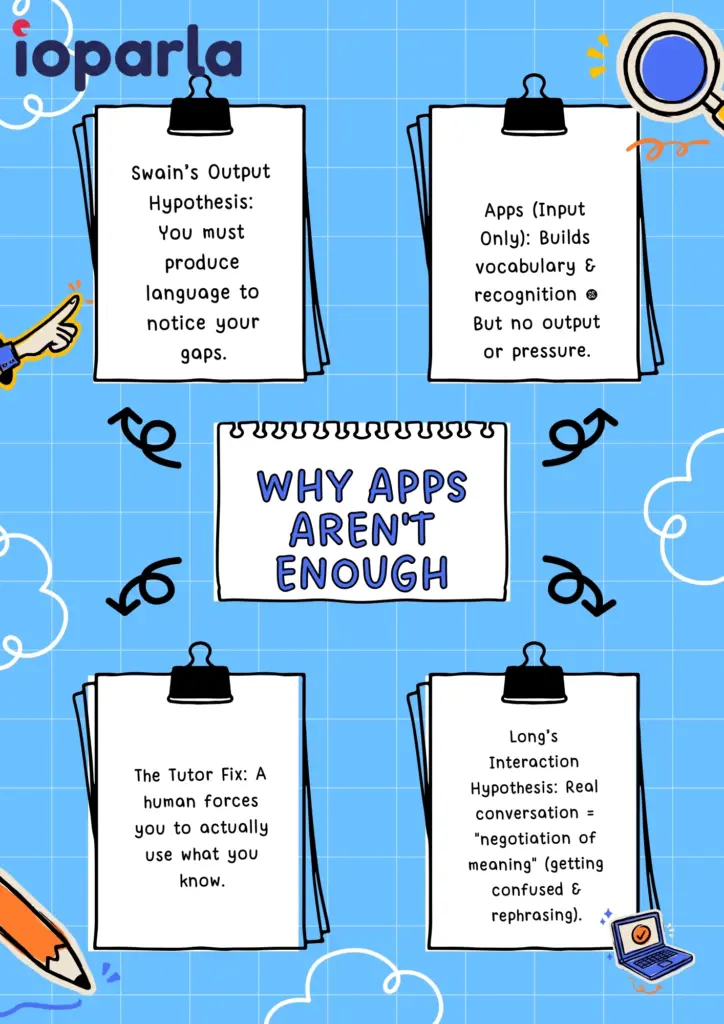
Free resources and official websites are an excellent starting point, but it takes time that most exam preparers just don’t have to put together ten different websites, monitor their own progress, and determine whether their writing or speaking is truly improving. IOPARLA was designed to bridge that gap. Instead of switching between tabs, you have access to everything in one location: live tutoring sessions, and self-paced lessons that you can review at any time, comprehensive TOEIC, TOEFL, and IELTS practice exams that replicate the actual exam conditions. When you’re ready for a structured plan rather than a disorganized one, IOPARLA is available to assist you..